


A crypto IRA is a self-directed individual retirement account that lets you buy and hold cryptocurrency, such as Bitcoin or Ethereum, for retirement. It works like a regular IRA and follows the same rules and contribution limits. The difference is that you invest in digital assets through a custodian and crypto exchange instead of stocks or mutual funds.
Key Takeaways
- A crypto IRA (also called a Bitcoin IRA) is a self-directed IRA that lets you hold cryptocurrency and other alternative assets like real estate or precious metals inside a tax-advantaged retirement account.
- The IRS treats crypto as property. Inside a Traditional IRA, your gains grow tax-deferred; inside a Roth IRA, qualified gains can come out tax-free.
- There are two ways to invest: the simple custodian-direct method, or the advanced LLC (“checkbook”) method for more control.
- Main trade-offs: crypto is highly volatile, and crypto IRAs charge higher fees than regular IRAs, so diversify and pick a reputable provider.
What is a Crypto IRA?
A crypto IRA, sometimes called a Bitcoin IRA, is a type of self-directed IRA that lets you hold cryptocurrency in your retirement account. A standard IRA usually limits you to stocks, bonds, and mutual funds. A self-directed IRA opens the door to alternative assets like crypto, real estate, and precious metals.
Cryptocurrency is a digital asset built on blockchain, a secure, decentralized ledger that records every transaction. Over the past decade, it has grown from a niche idea into an asset class that major financial institutions now take seriously.
Holding crypto inside an IRA gives you two things you don’t get on a regular exchange: tax advantages and a built-in long-term mindset. Instead of owing tax every time you trade, your gains can grow tax-deferred or even tax-free.
What are the Benefits of a Crypto IRA?
Holding crypto in an IRA comes with a few real upsides:
- Tax-advantaged growth. In a regular exchange, every profitable trade can trigger tax. Inside an IRA, gains grow tax-deferred (Traditional) or tax-free (Roth).
- Diversification. Crypto behaves differently from stocks and bonds, so a small allocation can spread out your risk.
- Access to an emerging asset. An IRA is a simple way to get long-term exposure to a fast-growing asset class without trading it in a taxable account.
Good to know: A crypto IRA follows the same annual limits as any IRA: $7,500 in 2026 ($8,600 if you’re 50 or older). See the next section.
How Does a Crypto IRA Work?
A crypto IRA works just like a normal IRA: you contribute money, invest it, and let it grow until retirement. The difference is what you’re buying and who holds it. Here’s the flow:
- Pick your IRA type. Choose Traditional (tax-deferred growth) or Roth (tax-free qualified withdrawals).
- Fund the account. Make a new contribution, transfer another IRA, or roll over an old 401(k).
- Buy crypto. Through your provider’s platform, purchase Bitcoin, Ethereum, or other supported coins.
- Store it securely. A qualified custodian holds your assets, usually in insured cold storage. You can’t keep the keys in a personal wallet.
Because the IRS treats the account as an IRA, you don’t report each trade personally; the custodian handles tax reporting (Forms 5498 and 1099-R).
Two ways to hold crypto in an IRA
There isn’t just one path. Most people start with the first option:
- Custodian-direct (simplest): You open a crypto IRA with a provider, and they handle custody, security, and IRS reporting. You just choose what to buy. Lower effort, lower compliance risk.
- IRA LLC / “checkbook control” (advanced): Your IRA owns an LLC, and you manage the LLC to trade directly. More control and potentially lower per-trade fees, but you take on the compliance responsibility yourself.
Quick rule of thumb: if you want simple and safe, go custodian-direct. If you’re experienced, trade often, and understand the rules, the LLC route may save on fees.
How to Invest in a Crypto IRA?
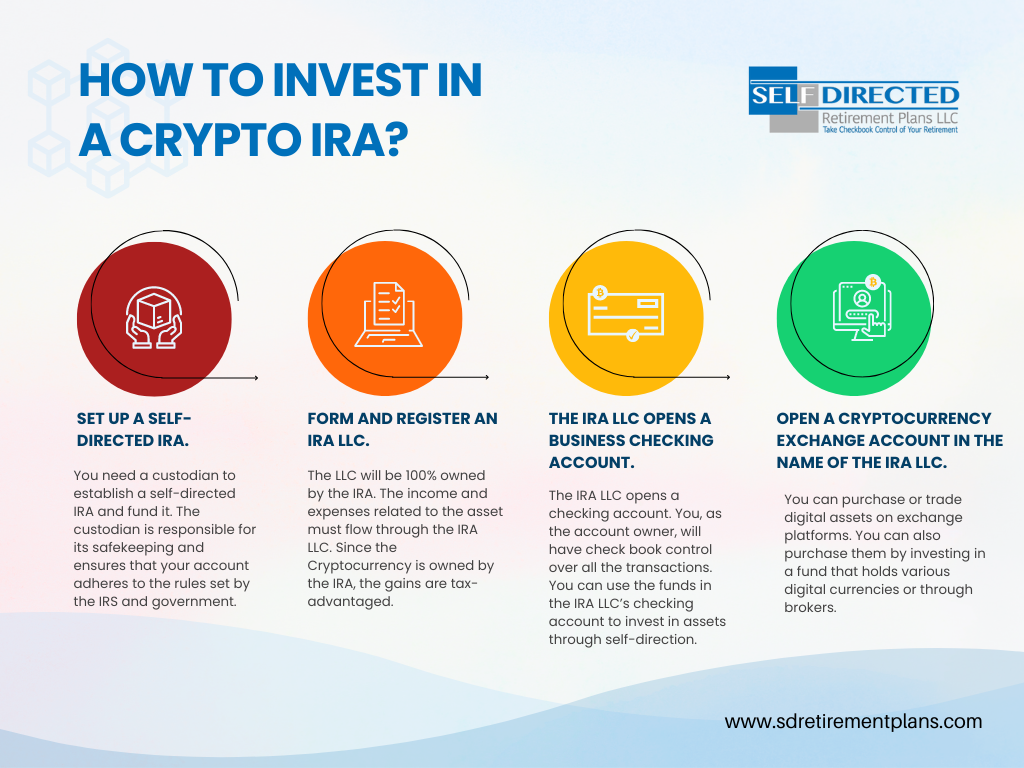
To hold Cryptocurrency in a retirement account, you must make the investment through an LLC. Here are the steps
-
Set up a self-directed IRA.
You need a custodian to establish a self-directed IRA and fund it. The custodian is responsible for its safekeeping and ensures that your account adheres to the rules set by the IRS and government.
-
Form and register an IRA LLC.
The LLC will be 100% owned by the IRA. The income and expenses related to the asset must flow through the IRA LLC. Since the Cryptocurrency is owned by the IRA, the gains are tax-advantaged.
-
The IRA LLC opens a business checking account.
The IRA LLC opens a checking account. You, as the account owner, will have checkbook control over all the transactions. You can use the funds in the IRA LLC’s checking account to invest in assets through self-direction.
-
Open a Cryptocurrency exchange account in the name of the IRA LLC.
You can purchase or trade digital assets on exchange platforms. You can also purchase them by investing in a fund that holds various digital currencies or through brokers.
How Much Can You Put in a Crypto IRA?
A crypto IRA shares the same yearly limit as any IRA. For 2026:
| Your age in 2026 | Maximum contribution |
| Under 50 | $7,500 |
| 50 or older | $8,600 (includes catch-up) |
This limit covers all your IRAs combined. Roth IRAs also have income limits, so high earners may be partly or fully phased out. For the full breakdown, see our guide to IRA contribution limits.
Potential Risks of a Crypto IRA
Crypto IRAs carry real risks. Know these before you invest:
- High volatility. Crypto prices can swing sharply in short periods. Only invest what you can leave alone for the long term, and keep your crypto allocation modest.
- Higher fees. Unlike many regular IRAs, crypto IRAs often charge setup, custody, maintenance, and per-trade fees. Over time, these can eat into returns.
- Scams and security. The crypto space attracts fraud. Stick with established, insured providers and never share account access.
- Compliance risk (LLC route). If you use the LLC method, a prohibited transaction can disqualify the entire IRA. When in doubt, get professional advice.
What Does a Crypto IRA Cost?
Costs vary by provider, but most charge some mix of these:
- Setup fee: a one-time charge to open the account (often $0–$50).
- Custody/maintenance fee: an ongoing fee, charged yearly or monthly, sometimes as a percentage of your balance.
- Trading fee: a charge each time you buy or sell, commonly around 1%–2% per trade.
Tip: compare total cost, not just one fee. A low trading fee with a high annual fee can still cost more if you trade rarely.
How do Crypto IRA Taxes Work?
- Traditional crypto IRA: Contributions may be tax-deductible now. Your money grows tax-deferred, and you pay ordinary income tax when you withdraw in retirement.
- Roth crypto IRA: Contributions are made with after-tax money. Growth is tax-free, and qualified withdrawals in retirement, including gains, aren’t taxed.
Withdrawal rules to remember:
- Age 59½: withdraw without the 10% early-withdrawal penalty.
- RMDs at 73: Traditional IRAs require minimum distributions starting at age 73. Roth IRAs have no RMDs during your lifetime.
Crypto Investments in an IRA: Rules and Things to Consider
Some of the things you need to be aware of before making Crypto investments in an IRA include
- You can’t sell your own crypto to your IRA, or buy from it, that’s a prohibited transaction.
- The IRS treats crypto as property, so the same IRA rules and tax treatment apply.
- Your exchange or platform must follow IRS rules for IRA-held assets.
- Crypto in an IRA must be held by a qualified custodian; you can’t self-custody in a personal wallet. With the LLC method, assets stay in the LLC’s name, never yours.
- Breaking these rules can disqualify the whole IRA and trigger taxes and penalties, so when unsure, talk to a tax professional.
Conclusion
A crypto IRA lets you tap into a fast-growing asset class while keeping the tax perks of a retirement account. It isn’t for everyone; the volatility and fees are real, but for long-term investors who want exposure to digital assets, it can be a smart way to diversify.
Start simple with a custodian-direct account, keep your crypto allocation reasonable, and talk to a tax professional before you begin.
Also Read: What is a Gold IRA & How Does it Work?
Protect and grow your wealth with a Crypto IRA
Frequently Asked Questions About Crypto IRA
Is a crypto IRA the same as a Bitcoin IRA?
Mostly yes. “Bitcoin IRA” is just a common nickname. A crypto IRA can hold Bitcoin plus other coins like Ethereum, depending on what your provider supports.
Can I hold crypto in my existing IRA?
Usually not directly. Standard IRAs limit you to stocks, bonds, and funds. To hold actual coins you generally need a self-directed crypto IRA, though some IRAs allow indirect exposure through crypto ETFs.
How much can I contribute to a crypto IRA in 2026?
Up to $7,500 if you’re under 50, or $8,600 if you’re 50 or older — the same limit as any IRA, across all your IRAs combined.
Disclaimer: The information provided in this article is for educational and informational purposes only and should not be construed as financial, tax, or legal advice. Financial regulations and retirement plan rules are subject to change, and individual circumstances vary. We strongly recommend consulting with a qualified financial advisor, tax professional, or legal expert before making any decisions regarding your 401(k) or retirement accounts.

